

Blog

React vs
Angular vs Node.js: Choosing the Right Stack for Web Apps in Chennai
Introduction Picking a tech stack feels like a developer
decision, but it’s really a business decision —

Introduction
Picking a tech stack feels like a developer decision, but it’s really a business decision — the stack you choose affects how fast you can launch, how much it costs to add features later, and how well your web application performs under real traffic. If you’re building or rebuilding a web application in Chennai, the React vs Angular vs Node.js question comes up almost immediately, and getting it wrong can mean rebuilding from scratch a year in.
This guide breaks down what each technology actually does, how they compare, and which combination makes sense for different types of businesses — so you can have an informed conversation with your development partner instead of just taking their word for it.
Why the Right Tech Stack Matters for Chennai Businesses
Chennai’s web application market spans everything from D2C e-commerce and SaaS products to healthcare platforms and hotel/hospitality management systems. Each of these has different demands — a booking platform needs real-time updates and reliability, a SaaS dashboard needs fast iteration and a rich component ecosystem, and a healthcare portal needs long-term maintainability and strict data handling. The stack you pick either supports those demands from day one or fights you the whole way.
React vs Angular: Choosing Your Frontend Framework
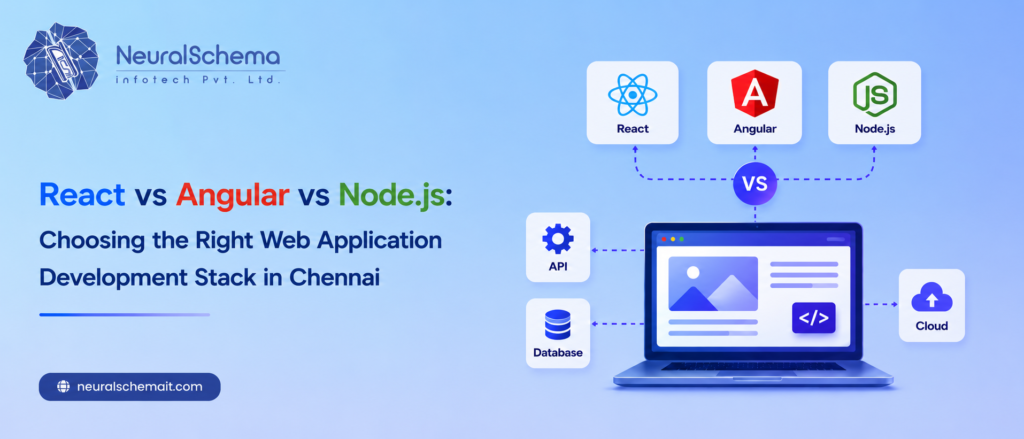
React and Angular both build the part of your web application that users actually see and interact with, but they take very different approaches. React is a flexible library that pairs with other tools as needed; Angular is a complete, opinionated framework with everything built in.
Factor | React | Angular |
|---|---|---|
Type | Library (flexible, pick your own tools) | Full framework (opinionated, batteries-included) |
Learning Curve | Moderate — easier for teams to onboard quickly | Steeper — more concepts to learn upfront |
Best For | Startups, fast-moving products, custom UIs | Large enterprise apps, complex forms, dashboards |
Ecosystem | Very large third-party library ecosystem | Comprehensive built-in tooling, smaller third-party need |
Developer Usage (2026) | ~44.7% of developers | ~18.2% of developers |
Typical Adopters | Meta, Airbnb, most modern startups | Google, Microsoft, Deutsche Bank, large banks |
Where Node.js Fits: Your Backend Engine
Node.js isn’t a competitor to React or Angular — it’s the backend runtime that powers the server side of your application, handling things like databases, APIs, authentication, and real-time features. It pairs naturally with either frontend framework: React + Node.js forms the popular MERN stack (MongoDB, Express, React, Node), while Angular + Node.js forms the MEAN stack (MongoDB, Express, Angular, Node).
- Widely adopted: Node.js remains the single most-used web framework among developers globally in 2025-2026, at roughly 48.7% adoption.
- Built for real-time: Its non-blocking, event-driven architecture makes it a strong fit for real-time features like live booking updates, chat, and notifications.
- TypeScript-ready: Over 70% of professional Node.js environments now use TypeScript, making large codebases easier to maintain long-term.
- Enterprise-proven: Netflix, Uber, PayPal, and Walmart all run Node.js in core production systems — proof it scales well beyond small projects.
The alternative backend options worth knowing — Python/Django, Java/Spring, and PHP/Laravel — each have their place, but Node.js’s biggest practical advantage for most Chennai businesses is using JavaScript across the entire stack, which means one team can work on both frontend and backend without switching languages.
Cost & Timeline Implications
Stack Combination | Typical Timeline (MVP) | Best Fit |
|---|---|---|
React + Node.js (MERN) | 8–14 weeks | Startups, SaaS products, e-commerce, fast-moving teams |
Angular + Node.js (MEAN) | 10–16 weeks | Enterprise dashboards, large internal tools, complex forms |
React + Python/Django backend | 10–16 weeks | Data-heavy apps, AI/ML-integrated products |
Timelines vary with feature complexity and integrations, but as a rule: React-based stacks tend to move faster in early development due to a larger talent pool and component ecosystem, while Angular-based stacks often pay off in very large, long-lived enterprise applications where built-in structure reduces long-term maintenance overhead.
How We Choose the Right Stack for Web Application Development in Chennai
There’s no universally “best” stack — only the right stack for your specific goals, timeline, and team. As a web application development company in Chennai, we start every project by mapping your business requirements (expected traffic, real-time needs, integrations, and growth plans) against stack trade-offs like the ones above, rather than defaulting to whichever framework a developer personally prefers.
Our web application development services in Chennai cover the full range — React and Node.js for fast-moving products, Angular where enterprise structure matters, and everything in between. If you’re evaluating partners, it’s worth reading how to choose the best web application development company in Chennai before committing to a stack or a vendor.
Frequently Asked Questions
For most new projects — especially startups and fast-moving businesses — React’s flexibility and larger talent pool make it the faster, more cost-effective starting point. Angular tends to make more sense for very large enterprise applications with complex internal workflows.
MERN stands for MongoDB, Express, React, and Node.js — a fully JavaScript stack that lets one development team handle both frontend and backend, speeding up development and reducing hiring complexity.
Yes, but it’s costly — a full frontend rewrite is a significant undertaking. This is exactly why choosing the right stack upfront, based on realistic 2-3 year growth plans, matters more than picking whatever is trendiest today.
Yes. Poorly implemented React or Angular apps can suffer from slow initial load times if not set up with server-side rendering or proper optimization. A well-architected Node.js backend and optimized frontend build process are essential for good Core Web Vitals scores.
Start with your requirements, not the technology: expected user volume, real-time features, integration needs, and your 2-3 year roadmap. A good development partner will map these to stack options rather than pushing a default choice.
Not Sure Which Stack Fits Your Project?
Every business’s requirements are different, and the right stack decision can save months of development time and significant cost down the line. Talk to our team for a free technical consultation before you commit to a framework or a development partner.
Recent Posts
- How to Find & Use Multimodal Search Data in GSC (Step-by-Step with Screenshots)
- Google Business Profile Post Views Are Back: What the Number Means for Your Business
- Website or Mobile App First A Practical Guide for Growing Businesses
- 10 Best Mobile App Development Companies in Chennai 2026 Guide
- Google August 2026 Spam Update: What Businesses Need to Know