

Blog

Flutter vs
Native Apps: Which is Best for Your Project in 2026?
Introduction: Why Execution Matters More Than Strategy in 2026
If you’re planning to develop a mobile application

Introduction: Why Execution Matters More Than Strategy in 2026
If you’re planning to develop a mobile application in 2026, you’ve likely come across two popular options: Flutter and native app development. Both have their strengths, but choosing the right one for your project can significantly impact your development timeline, budget, and app performance.
In this comprehensive guide, we’ll compare Flutter vs native apps across key metrics including development cost, performance, time-to-market, and user experience. By the end, you’ll have a clear understanding of which approach is best for your business needs in 2026.
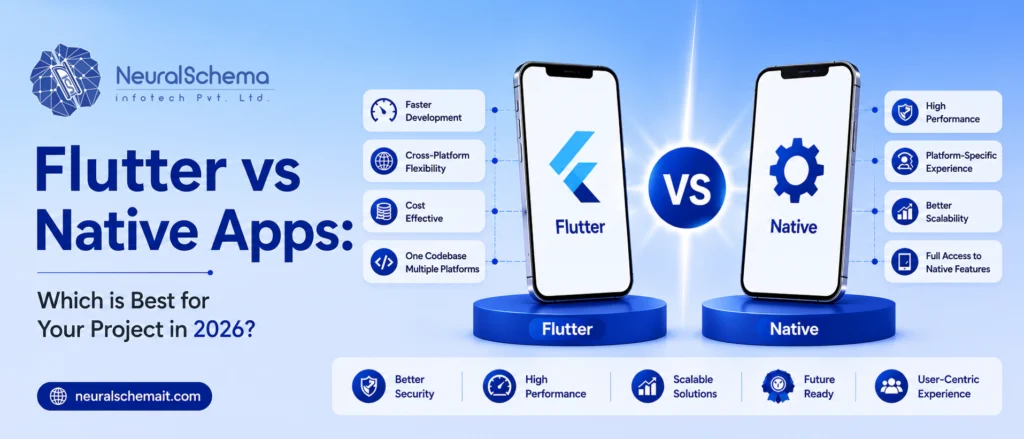
What are Native Apps vs Flutter?
Native App Development
Native apps are built specifically for a single platform using platform-specific programming languages and tools.
For example:
iOS apps are built using Swift or Objective-C and developed with Xcode
Android apps are built using Java or Kotlin and developed with Android Studio
Native apps have full access to the device’s hardware and software capabilities, resulting in superior performance and optimal user experience. However, you’ll need separate development teams and codebases for iOS and Android.
Flutter App Development
Flutter is an open-source, cross-platform mobile development framework created by Google. It uses Dart programming language and allows developers to build applications for both iOS and Android from a single codebase.
Key characteristics of Flutter:
- Single codebase for iOS, Android, web, and desktop
- Hot reload feature for faster development
- Rich set of pre-built widgets for UI design
- Reduced development time and cost
Key Differences Between Flutter and Native Development
Aspect | Native Apps | Flutter Apps |
|---|---|---|
Codebase | Separate iOS and Android code | Single unified codebase |
Language(s) | Swift/Objective-C (iOS), Java/Kotlin (Android) | Dart |
Development Time | Longer (separate teams/code) | Faster (single codebase) |
Performance | Excellent (native compilation) | Very Good (near-native) |
Cost | Higher (2 teams, 2 codebases) | Lower (1 team, 1 codebase) |
Platform Support | iOS & Android primarily | iOS, Android, Web, Desktop |
Learning Curve | Steep (multiple languages) | Moderate (single language) |
Performance Comparison: Which is Faster?
One of the biggest questions developers ask: Does native app performance beat Flutter in 2026?
Native App Performance:
Native apps are compiled directly to machine code specific to each platform (iOS or Android). This means:
- Faster app startup times
- Optimal memory usage
- Smoother animations and transitions
- Direct access to device features and APIs
Flutter Performance:
Flutter uses ahead-of-time (AOT) compilation, which compiles Dart code to native machine code. By 2026, Flutter’s performance has matured significantly and is now comparable to native apps for most use cases.
Flutter’s performance advantages:
- Near-native performance for most business applications
- Fast hot reload for development
- Efficient garbage collection
- Smaller app size compared to cross-platform alternatives
Verdict: For most apps in 2026, Flutter performance is indistinguishable from native. Native apps still have an edge for graphics-intensive applications (games) or apps requiring heavy hardware access.
Cost Analysis: Flutter vs Native Development
Development cost depends on project complexity, features, platform requirements, design scope, third-party integrations, and the development team’s location. Flutter generally reduces development costs because a single codebase can be used for multiple platforms.
Development Time: Time-to-Market Comparison
Flutter projects are generally completed faster than native projects because developers maintain a single codebase for Android and iOS. However, the actual timeline depends on the application’s complexity and business requirements.
When to Choose Flutter vs Native Apps
The right choice depends on your specific project requirements. Here’s a decision guide for 2026:
Choose Flutter When:
- You need to launch on both iOS and Android simultaneously
- Budget is a priority – you need to save on development costs
- Time-to-market is critical – you need to launch quickly
- Your app is business logic-heavy (not graphics-intensive)
- You also need web and desktop versions (Flutter supports all platforms)
- Your team is familiar with Dart or willing to learn it
- You’re building MVPs or startup products with limited budgets
Choose Native Apps When:
- You need maximum performance and optimal battery efficiency
- Your app is graphics-intensive (games, AR apps, video apps)
- You need access to advanced platform-specific APIs
- You have separate iOS and Android teams with expertise in those platforms
- Your budget allows for separate codebases and longer development time
- You’re building enterprise apps requiring maximum platform integration
Real-World Examples: Flutter vs Native in 2026
Many startups and enterprises use both Flutter and native technologies depending on their business goals, scalability requirements, and user experience expectations.
Frequently Asked Questions
Flutter delivers near-native performance for most business applications, while native development remains the preferred choice for graphics-intensive apps and hardware-specific functionalities.
Flutter can reduce development costs in many projects because developers maintain a single codebase instead of separate Android and iOS applications. However, the actual cost savings depend on the project’s scope, complexity, and business requirements.
Yes, absolutely. Flutter apps can be published on both the Apple App Store and Google Play Store without any issues. The build process is straightforward, and Flutter apps meet all platform requirements.
Yes, Flutter is increasingly used for enterprise applications in 2026. Flutter is widely adopted for enterprise application development due to its scalability, maintainability, and cross-platform capabilities. The suitability of Flutter depends on the application’s requirements and long-term business goals.
For most startups in 2026, Flutter is the better choice because it allows you to launch faster with limited budget. You can build both iOS and Android versions simultaneously, reach market quickly, and iterate based on user feedback. As your app grows and performance becomes critical, you can always migrate to native later.
Conclusion
Both Flutter and native app development have their merits in 2026. The choice ultimately depends on your project requirements, budget, timeline, and team expertise
Need Help Choosing the Right Approach for Your App?
Choosing between Flutter and native app development depends on your business goals, budget, and technical requirements. At NeuralSchema IT, we develop custom Flutter and native mobile applications tailored to your unique business needs, helping organizations build scalable, secure, and high-performance mobile solutions.
Ready to build the brand your startup deserves?
Contact our team to know more about it and let’s build the right solution for your business.
Recent Posts
- How to Find & Use Multimodal Search Data in GSC (Step-by-Step with Screenshots)
- Google Business Profile Post Views Are Back: What the Number Means for Your Business
- Website or Mobile App First A Practical Guide for Growing Businesses
- 10 Best Mobile App Development Companies in Chennai 2026 Guide
- Google August 2026 Spam Update: What Businesses Need to Know