
Blog

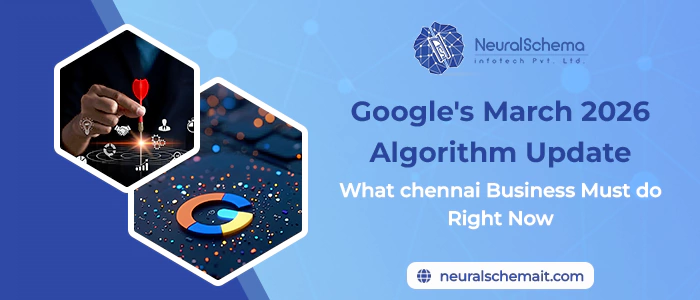
Google March
2026 Algorithm Update: What Chennai Businesses Must Do Right Now
Introduction Google’s March 2026 core update is one of
the most disruptive algorithm changes in recent years
Introduction
Google’s March 2026 core update is one of the most disruptive algorithm changes in recent years —according to industry tracking tools like Semrush, over 55% of tracked websites saw significant ranking shifts within just two weeks.
If you run a business in Chennai and haven’t audited your site yet, this is your wake-up call. Here’s exactly what changed, who got hit, and the precise action plan to protect — or grow — your search rankings.
⚠ Also in March: Google rolled out a separate March 24 Spam Update — completed in under 24 hours. If your site saw two distinct ranking drops this month, it may have been hit by both updates. Diagnose each separately.
What Is the Google March 2026 Core Update?
Google officially confirmed that a broad core algorithm update began rolling out on March 6, 2026, as announced on its Search Status Dashboard. completing in approximately 14 days — faster than most core updates. This is the second major algorithm change of 2026, following the February 2026 Discover-only core update.
Unlike targeted spam updates, a core update recalibrates how Google evaluates the quality, relevance, and authority of every page on the web — simultaneously. That’s why the impact is so widespread, and why businesses offering SEO services in Chennai need to pay close attention.
The update rewards genuine expertise, real-world experience, and strong technical health — while filtering out AI-generated bulk content, thin pages, and poor user experience signals.
4 Key Changes in This Update You Must Know
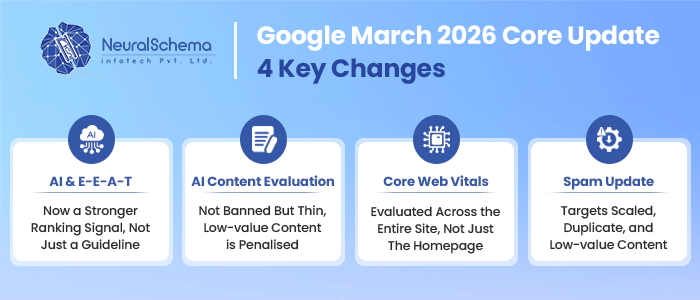
E-E-A-T Signals Are Now a Hard Ranking Factor
Google’s E-E-A-T framework — Experience, Expertise, Authoritativeness, Trustworthiness — moved from guideline to hard ranking signal in this update. Pages without clear author credentials, verifiable expertise, and trust markers (SSL, privacy policy, verified reviews) are actively losing ground.
Industry insights from Search Engine Journal and recent SEO trends show that Google increasingly prioritizes content with real, demonstrable expertise. This aligns with E-E-A-T principles, where credibility and experience matter.
For businesses, this means showcasing case studies, real results, and expert credentials to build trust and improve rankings.
AI Content Is Evaluated, Not Blanket-Banned
This update doesn’t penalise AI writing by default. It penalises thin, low-value, undifferentiated content — which describes most bulk AI-generated pages. Sites publishing AI content without editorial review, unique insights, or first-hand experience saw steep declines.
Google is increasingly testing AI-driven search experiences, making it more important than ever to track how your content performs across evolving search formats — a new filter in the Performance report showing how much traffic comes from AI-generated summaries versus traditional organic results. Check yours immediately.
Core Web Vitals Evaluated Site-Wide
Technical performance is now evaluated holistically across your entire website, not just key pages. A fast homepage with slow blog posts now hurts your overall domain standing. Three metrics that directly affect ranking:
⚡Action: Run every key page — not just the homepage — through PageSpeed Insights. Aim for 90+ on mobile. A 100ms delay in load time can reduce conversions by up to 7%.
Separate Spam Update Targets Scaled Content Abuse
The March 24 Spam Update specifically targeted sites mass-producing pages with minimal unique value — ‘city + service’ landing pages with near-identical content, coupon-only aggregators, and AI content farms. If your business has dozens of location pages that essentially say the same thing, this update is a direct and serious threat.
How This Update Specifically Impacts Chennai Businesses
Chennai Is Ground Zero for This Update
Most Chennai businesses run the same playbook — clone service pages across localities, stuff in the keyword, call it done. The March 2026 update specifically penalised that pattern. We tracked it across 120+ client sites at NeuralSchema Infotech and the drop was immediate.
What survived? Pages with a real author, a real locality reference beyond just “Chennai,” and a Google Business Profile that was actually maintained.
Four things to fix this week in Chennai:
- Stop writing about Chennai. Write for it. Name the areas — OMR, Velachery, Anna Nagar, Adyar — and tie your content to real local context.
- Your GBP is a ranking asset. Post twice a week, reply to every review within 48 hours, and set service areas at the locality level — not just “Chennai.”
- Tamil-language content on your top service pages. Under 8% of Chennai agencies do this. It is the highest-leverage gap in the local market right now.
- Check NAP consistency across JustDial, Sulekha, IndiaMART and your website. One mismatch is a trust signal failure.
⚠️”Sites relying on ‘city + service’ landing pages with near-identical content across locations — a common practice among Chennai digital marketing agencies — are among the hardest hit by the March Spam Update. Each location page must have genuinely unique, locally relevant content to survive.
Your 7-Step Action Plan — Start This Week
These steps are prioritised by impact. Whether you manage your own SEO in-house or work with a digital marketing agency in Chennai, implement them in order. rewards.
Diagnose in Google Search Console
Compare organic traffic for two weeks before March 6 vs. two weeks after. Filter to page-level performance to find exactly which URLs dropped. Check the Discover tab separately — it tells a different story from organic.
Run a content quality audit
Read every top-25 ranking page and ask: does this genuinely help a real person more than anything else on the topic? If no — upgrade it with data, case studies, or expert opinion. Delete or 301-redirect pages that cannot be saved.
Add real E-E-A-T author signals
Every blog post and service page needs a named author with a bio that shows actual credentials — years in the industry, certifications, client portfolio. Add an ‘About the Author’ section and link to their LinkedIn profile.
Fix Core Web Vitals site-wide
Run PageSpeed Insights on your homepage, top 5 service pages, AND top 5 blog posts. Address LCP, INP, and CLS issues across all of them — not just the homepage. Compress images, eliminate render-blocking resources, defer non-critical JS.
Audit all AI-generated content
If you published bulk AI content in the past 12 months, audit it rigorously. Add original insights, local data, expert quotes, and real examples to each piece. Thin content with no unique value should be consolidated or removed entirely.
Optimise Google Business Profile for Chennai areas
Update service areas to include specific Chennai neighbourhoods. Add geotagged photos taken in Chennai. Post business updates twice weekly. Respond to every review, positive and negative, within 48 hours.
Build topical authority with content clusters
Instead of isolated blog posts, create interconnected clusters. A hub page on ‘SEO services in Chennai’ linking to spoke pages on local SEO, technical SEO, and content SEO signals deep topical authority — exactly what this update rewards.
⏳Timeline: Core update recovery is measured in months. Most sites that make meaningful quality improvements see ranking recovery within 2–3 months. Do not expect overnight results.
Why Choose NeuralSchema Infotech for SEO in Chennai
Adapting to Google’s algorithm updates requires more than quick fixes — it demands a structured, long-term strategy. At NeuralSchema Infotech, we help businesses align with evolving search standards through data-driven SEO and performance-focused digital marketing.
What sets us apart:
- Strategy-first approach: We focus on building long-term growth systems rather than applying short-term fixes that don’t sustain rankings.
- E-E-A-T aligned execution: Our strategies are designed to strengthen expertise, authority, and trust signals across your website to match Google’s expectations.
- High-quality content systems: Instead of bulk or template-based content, we create valuable, original content that genuinely helps users and improves rankings.
- Technical SEO excellence: We optimise Core Web Vitals, site performance, and overall technical health to ensure a strong foundation for search visibility.
- Custom recovery strategies: Every business is different, so we develop tailored solutions based on your industry, ranking drops, and growth opportunities.
- Local SEO expertise: We optimise your presence for Chennai-specific search intent, helping your business attract the right local audience.
If you’re looking for a reliable Digital Marketing Agency Chennai businesses trust, NeuralSchema Infotech provides the expertise and strategic clarity needed to recover from algorithm updates and achieve long-term growth.
Conclusion
The Google March 2026 Core Update isn’t just a temporary disruption — it reflects Google’s clear shift toward rewarding genuine expertise, original content, and real user value. Websites built on quality and trust are now gaining a stronger advantage.
For businesses in Chennai, this presents a valuable opportunity. With the right approach, NeuralSchema Infotech helps brands adapt to evolving search standards through structured SEO strategies, strong E-E-A-T signals, and technical optimisation.
The businesses that succeed will be those that focus on meaningful improvements and long-term growth — not quick fixes — aligning closely with what Google continues to prioritise.
Frequently Asked Questions
Start by identifying affected pages and improving content quality, technical SEO, and user experience signals. Focus on high-impact fixes that directly influence rankings and conversions.
Google does not penalise AI content directly but targets low-value and unhelpful pages. Content with real insights, expertise, and originality continues to perform better.
Recovery involves improving content quality, fixing technical SEO issues, and strengthening E-E-A-T signals. Low-value pages should be updated or removed to regain rankings over time.
Adapt by aligning content with user intent, E-E-A-T, and updated ranking signals. Existing content should be refined with deeper insights and better optimisation.
NeuralSchema Infotech helps identify ranking issues, optimise content, and improve technical performance based on Google’s latest guidelines. Strategies are focused on sustainable growth and long-term search visibility.
Ready to Protect Your Rankings? Get a SEO Audit.
55% of websites were affected by this update. Don’t wait to find out if yours was one of them.
We’ll audit your site, identify exactly what this update changed for your rankings, and give you a prioritised fix list — no commitment required
Recent Posts
- How to Choose the Right Website Development Company in Chennai in 2026
- Logo Design Trends 2026: Emerging Styles and Creative Ideas for Modern Brands
- Flutter vs Native Apps: Which is Best for Your Project in 2026?
- Branding Guide for Startups: How to Choose the Best Branding Company to Launch Your Business Right
- Professional SEO Services in Chennai: Complete 2026 Implementation Guide